Rogue Brutal IPA Kit
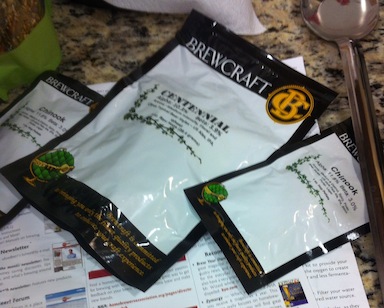
Earlier in the year, I thought that it would be cool to try out the Rogue kits, as I really loved their beer and was kind of curious how well the kits would turn out. I was especially curious because I saw that I could order Pacman Yeast, which is the custom yeast strain that Rogue uses for their beers. So I quickly ordered two beer kits from Rogue, and two packages of Pacman Yeast.
I ordered the Shakespeare Oatmeal Stout kit and the Brutal IPA kits. When I got them, the Shakespeare kit had some tiny holes in the DME bags, so everything was covered in a fine dust. The Brutal IPA kit was totally fine. When I ordered the yeast from homebrewers.com, I opted for the ice packs since it is a liquid yeast. Unfortunately, while I ordered it 2 weeks early, it decided to come just as I was going to be spending a week in San Francisco, and arrived while I was gone. When I got back, the ice packs were warm and the yeast packs were poofy.
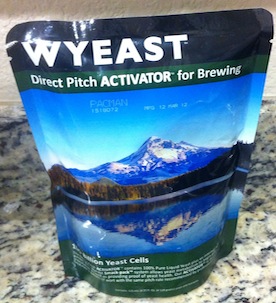
I decided to just put them in the fridge as is, and made the stout. I probably should have made a starter for the yeast, but it ended up awesome anyway. Fast forward a month later, and now I am brewing the Brutal IPA kit. After doing the stout, and then looking at the instructions for the IPA, I noticed that the Rogue kits (and maybe all of the ones made by BrewMaster) are written to be very general. A lot of "if your kit includes ::blank:: then add it here" or "If brewing the Brutal IPA, do this". The instructions for the two differ, and in most of those "if this then this" situations, that instruction was unique to the beer I was brewing, so they were true. Stop making me think so much while I am brewing, and just tell me what I should be doing! I decided that I should stop stressing about the directions, it may not taste exactly like the beer it clones (I actually don't think I have ever tasted it), but will still be a good IPA either way, so I would just put the ingredients in at reasonable times. I know the recipes are probably more for beginners, but I think it would have been nice to just include a standard recipe, that lists the grains (with degrees to steep at), fermentables, and times to put the hops in.
I ended up doing a boil of 3 gallons (they usually recommend 2.5-3 gallons). Less will boil faster, but with 3 I will get closer to the estimated gravity and IBU measurements because I won't have to dilute it as much to get up to a full 5 gallons. I also did a late malt addition. The kit had 3 bags of malt, two smaller and one bigger, so I only added the bigger bag when it asked me to add the malt. I added the rest within the last 10 minutes of the boil. This serves two purposes: I am less likely to burn the malt if I don't add it all at once, and having the gravity of the wort be lower when doing the hop additions, it should help with hop utilization, leading to a more bitter and hoppy beer (which I love).
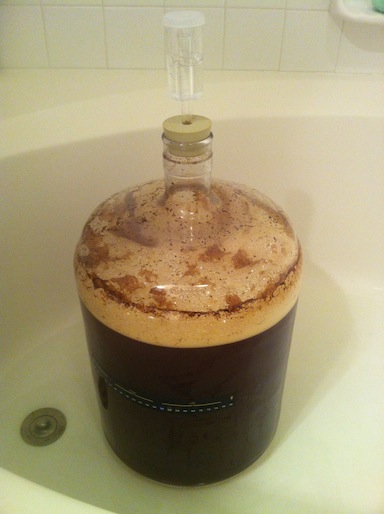
After transferring to the fermenter and pitching the yeast, I put the fermenter in the bathtub with some water in it. This beer should ferment around 64F, and it seemed like the bathroom was little bit too cool. It was around 61-64. I decided to empty out the water, and it still stayed around the same. Fermentation didn't start very quickly. There was bubbles in the airlock, but it didn't really form any krausen for a few days. Eventually it started, and the higher gravity of this beer compared to my others must have made it ferment more vigerously, as one day when I got back from work I noticed a little bit of the leftover krausen halfway up the airlock.
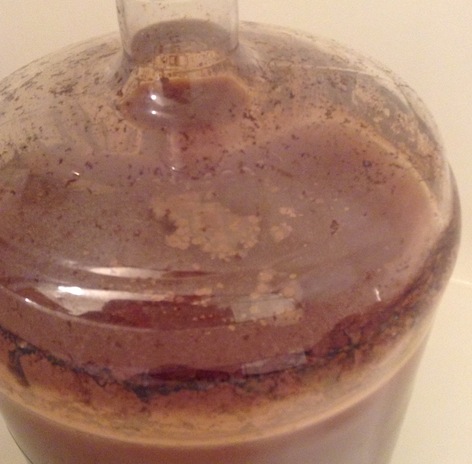
Once primary fermentation started settling down, about a 10 days into it, I noticed a lot of "yeast islands". I thought they were maybe infection at first, but since they just looked like clay and weren't growing anything, I decided they were fine. I decided that I should ferment it a little closer to the 64F that was recommended, so I moved the fermenter to the spare bedroom, which is where I normally ferment, and have to put wet towels over the fermenter to keep it cool. It seems like because it is winter still, and not in the middle of active fermentation, I am able to have it in the spare bedroom without any extra temperature control.
After 17 days in the primary, the airlock seemed like it had slowed down a lot. I decided to take a sample and measure with my hydrometer. The reading was 1.013, which is the expected final gravity, and the beer tasted pretty good so I decided to move on to the secondary and start dry hopping. The recipe called for 1 oz of Chinook, but I really enjoy the hoppy aroma that you get from dry hopping, so I decided to bump it up to 2 oz of Chinook. The recipe was a bit confusing, but it said that secondary should go 7-10 days and dry hopping should go for 5 days, but I think I will have the dry hopping go the full 10 days before I put it in the keg.
This is currently where my fermentation is at for this beer, so I will let you all know how the rest turns out!